Rental Property Maintenance Checklist for Dallas Landlords
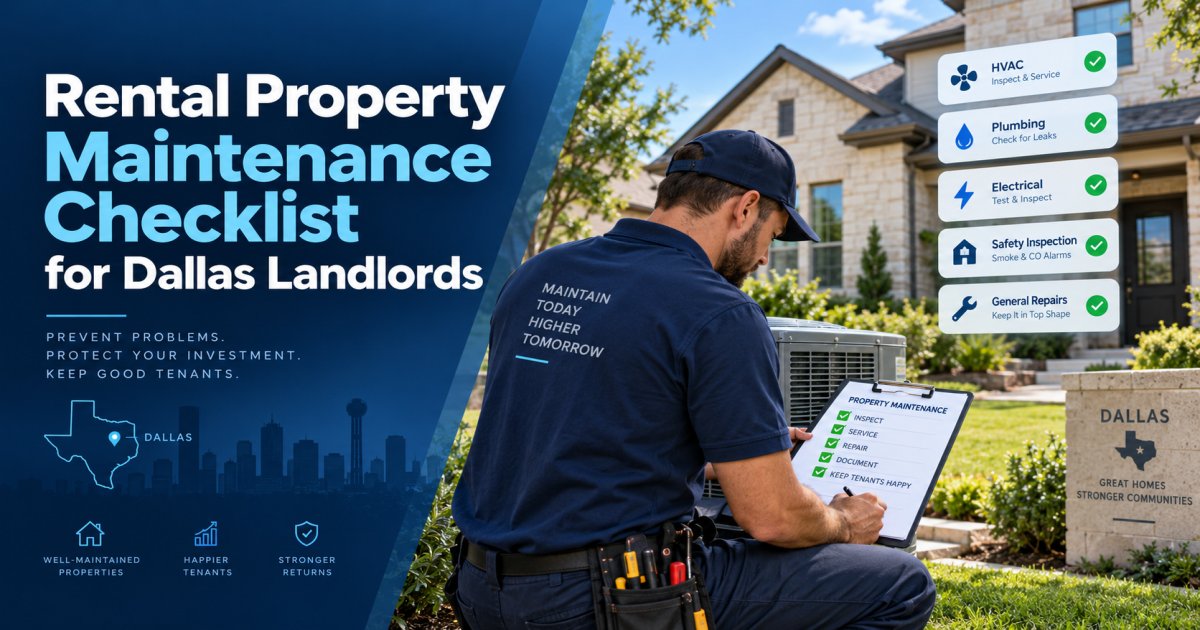
Rental Property Maintenance Checklist for Dallas Landlords
Rental-property maintenance becomes expensive when small problems are allowed to become emergencies.
A slow leak becomes water damage.
A dirty HVAC filter becomes an uncomfortable tenant call during a Texas heat wave.
A small roof issue becomes ceiling damage after severe weather.
For Dallas landlords, the goal should not simply be fixing problems.
It should be finding problems earlier and managing them systematically.
Here is a practical maintenance checklist for Dallas rental owners.
Monthly Rental Property Maintenance
Not every task requires visiting the property every month.
However, landlords should have systems for monitoring recurring issues.
Watch Active Maintenance Requests
Review:
- New requests
- Requests awaiting vendors
- Quotes requiring approval
- Jobs currently in progress
- Completed work
- Repeated issues at the same property
Repeated repairs can indicate that replacing an item may be more economical than continuing to repair it.
Monitor HVAC Issues
Air conditioning is particularly important in North Texas.
Tenants should know basic steps such as checking thermostat settings and filters before a technician is automatically dispatched for every cooling complaint.
This is an area where maintenance troubleshooting can significantly improve efficiency.
Spring Maintenance Checklist
Spring is a good time to prepare the property for hotter months.
Check:
- HVAC servicing
- Air filters
- Exterior drainage
- Roof condition
- Gutters
- Window and door seals
- Exterior faucets
- Irrigation systems
- Smoke and carbon-monoxide alarms as applicable
- Signs of moisture or leaks
- Pest-related issues
A relatively inexpensive inspection before summer may prevent a much more disruptive repair later.
Summer Maintenance Checklist
Dallas summers place significant demand on air-conditioning systems.
Prioritize:
- HVAC performance
- Filters
- Thermostat operation
- Condensate drain lines
- Signs of moisture
- Refrigerator and appliance issues
- Irrigation
- Exterior landscaping
Tenants should also know how to report urgent issues clearly.
Instead of:
“AC broken.”
A useful maintenance report contains:
- When the issue started
- Current thermostat temperature
- Whether air is flowing
- Whether the breaker has been checked
- Whether the filter appears blocked
- Photos where relevant
Better information helps the owner or vendor make a better decision.
Fall Maintenance Checklist
Fall provides an opportunity to prepare for cooler temperatures.
Review:
- Heating system
- Weather stripping
- Plumbing
- Exterior gaps
- Roof and gutters
- Trees near the property
- Water-heater condition
- Safety devices
It is also a useful time to review unresolved issues reported throughout the year.
Winter Maintenance Checklist
Although Dallas winters are typically milder than many northern markets, freezing weather can still create serious property problems.
Prepare tenants with appropriate instructions concerning:
- Protecting pipes during freezes
- Reporting leaks immediately
- Heating issues
- Outdoor faucets
- Emergency contact procedures
A landlord should never wait until a major weather event to establish the communication process.
What Counts as an Emergency Maintenance Request?
Owners should establish a system for distinguishing routine issues from potentially urgent ones.
Potentially urgent issues may include circumstances involving:
- Significant uncontrolled water
- Electrical hazards
- Serious heating or cooling issues depending on conditions
- Fire or smoke
- Major security problems
- Sewage
- Other conditions affecting health or safety
Actual legal repair obligations depend on the circumstances and applicable law.
The important operational lesson is to have a clear escalation process.
Why Traditional Maintenance Management Becomes Chaotic
A typical self-managing landlord might receive:
Tenant text → owner call → vendor text → tenant follow-up → vendor quote → owner approval → another tenant text → invoice email.
Nothing exists in one place.
Now multiply that by ten or twenty properties.
This is where maintenance management begins consuming a disproportionate amount of the landlord's time.
A Better Maintenance Workflow
A more organized system looks like this:
1. Tenant reports the problem
The request is recorded in a centralized system.
2. Initial troubleshooting occurs
Simple checks may resolve minor issues without a contractor visit.
3. The unresolved problem becomes a work order
The information collected from the tenant follows the request.
4. A vendor is assigned
The vendor sees the relevant details.
5. Quote is submitted
The property owner can review the proposed work.
6. Owner approves or rejects
Control remains with the owner.
7. Work is completed
The status is tracked.
8. Records remain attached to the property
Future decisions become easier because there is a maintenance history.
Where AI Can Help With Rental Maintenance
AI is particularly useful at the beginning of the maintenance process.
Imagine a tenant writes:
“My AC is running but the house isn't getting cold.”
Instead of immediately making the owner diagnose the problem, an AI troubleshooting workflow can gather additional information and suggest safe preliminary checks.
If the problem remains unresolved, the request can move into the work-order process.
AI does not need to replace the contractor or owner.
Its value is reducing unnecessary back-and-forth communication.
Track Maintenance Costs by Property
Landlords with multiple units should know:
- Which property generates the most requests
- Which equipment fails repeatedly
- Which vendors receive the most work
- Average repair costs
- Which jobs remain unresolved
- How much is being spent on maintenance
Without centralized records, these patterns are difficult to see.
Preventive Maintenance Protects Cash Flow
Maintenance should not only be viewed as an expense.
Good maintenance protects:
- Property value
- Tenant satisfaction
- Lease renewals
- Equipment lifespan
- Owner time
- Rental income
The cheapest repair is often the serious repair that never became necessary.
Frequently Asked Questions
How often should a landlord inspect a rental property?
Inspection frequency depends on the property, lease, applicable rules and circumstances. Owners should establish a reasonable preventive-maintenance schedule rather than relying entirely on tenant complaints.
What maintenance issues are common in Dallas rentals?
HVAC, plumbing, appliances, weather-related damage, drainage, roofing and general wear are common areas rental owners should monitor.
Can tenants troubleshoot maintenance problems themselves?
Some minor problems can be resolved through safe, simple checks. Tenants should never be encouraged to attempt potentially dangerous electrical, gas, structural or other specialized repairs.
How does AI help property maintenance?
AI can help collect information, classify requests, provide appropriate basic troubleshooting and move unresolved requests into structured workflows.
What is property-maintenance software?
Property-maintenance software centralizes tenant requests, work orders, vendor communication, approvals and repair history.
Turn Maintenance Requests Into an Organized Workflow
PropCompanion's property-management platform combines tenant maintenance requests, AI troubleshooting, work orders, vendor management and owner approvals.
Instead of tracking repairs through scattered texts and emails, manage the entire maintenance lifecycle from one place.

Keep exploring: screening rental applicants, how the AI maintenance assistant works, plans and pricing, or browse available rentals.